From recording to analysis
Signalino combines ADS1299-based electronics, acquisition software and tools for working with data. The current platform records eight 24-bit channels, with a default sampling rate of 250 samples per second. View a session, save it for later analysis or add acquisition to your own application.
Signalino Suite
The desktop application connects to the device, checks impedances, displays EEG and records sessions.
Share signals and synchronize an experiment
Lab Streaming Layer (LSL) is a system for sharing data between applications and aligning their recordings to a common time reference. Signalino Suite can use it to send EEG to compatible applications on the same computer or local network.
For example, an experiment can record EEG while another application marks when an image appears or a stimulus sounds. LSL helps relate these recordings so you can analyze the signal around each event.
You do not need LSL to view and save sessions in Signalino Suite; it is useful when combining Signalino with other tools. Learn more about LSL.
Preview installers are available for macOS Apple Silicon, Windows x64 and Ubuntu/Debian Linux amd64. These are evaluation releases: available features depend on the model, firmware and operating system. The installation notes and limitations describe the documented release status.
Browse Signalino Suite downloads and releases →
Your tools, your data
The Python API supports acquisition over USB, Bluetooth Classic or Bluetooth Low Energy, depending on the device. Install the public package with:
python -m pip install signalino
Optional LSL, MNE and viewer support can be installed with python -m pip install "signalino[all]". See the package and instructions on PyPI.
The platform uses 33-byte binary frames compatible with the OpenBCI format. BrainFlow integration is a release candidate and BCI2000 integration remains under validation; their availability is not yet equivalent to that of the Python API.
Evolving hardware
Signalino S3 is the current controller generation, based on ESP32-S3 and ADS1299. It supports native USB and BLE, impedance measurements, microSD recording and auxiliary sensor data when present. Final hardware validation of the S3 D5 revision remains pending.
Original Signalino Teensy units, based on Teensy 3.6, retain support over USB and paired Bluetooth Classic. When you enquire about availability, we will confirm the generation and configuration of your unit.
During this phase, Scignals programs and supports devices directly. Public firmware packages are pending release; installing the Suite does not imply a firmware update. Identify your model and check firmware availability.
The original platform: Arduino Due and LabVIEW
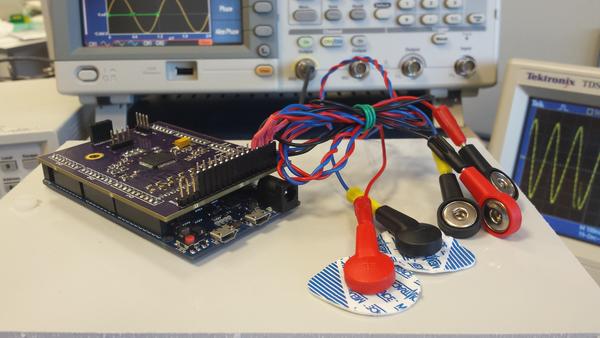
The version studied in the 2019 UC3M undergraduate thesis combines an eight-channel ADS1299 with 24-bit conversion and Arduino Due. Data reaches the computer over USB; a LabVIEW interface separates it by channel and displays it in real time.
This provides a reference for understanding the original architecture and signal path. Its specifications describe that version, rather than all current units.
Academic documentation
Optimización de Signalino: Amplificador comercial inalámbrico de bajo coste
Undergraduate thesis by Javier Guillén Colomer, Universidad Carlos III de Madrid, 2019. Supervisor: Nazario Félix-González.
The document covers the hardware architecture, ADS1299 configuration, Arduino program and development of the LabVIEW interface. It is a useful reference for understanding the platform and following the data from acquisition to visualization.