Can the brain’s electrical signals help us choose the right moment to deliver a stimulus during sleep? That is the idea behind closed-loop auditory stimulation, or CLAS.
This technology connects brain recordings with precisely timed sounds. It offers a way to explore interactions with sleep rhythms and better understand their relationship with memory.
What does «closed loop» mean?
In CLAS, EEG guides the delivery of brief sounds. The system records, analyses and stimulates, then keeps recording to decide when to act again.
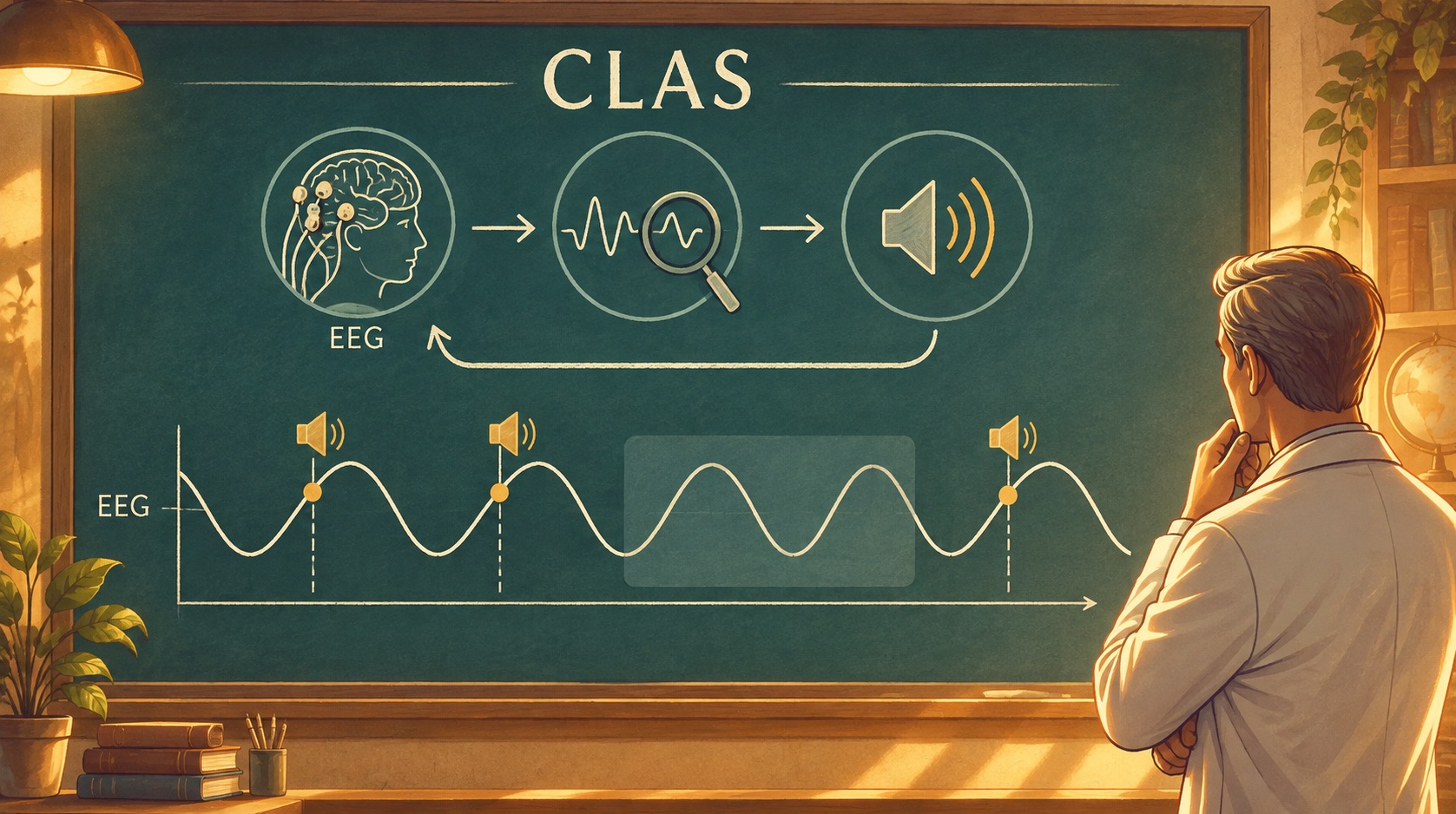
Timing is essential. Protocols targeting slow oscillations during non-REM sleep aim to deliver the stimulus at a particular phase of the oscillation. A 2013 study by Ngo and colleagues showed that this approach could strengthen slow oscillations and improve retention of word associations under the experimental conditions.
Why study sleep rhythms?
The interest extends beyond memory. The review by van Hattem and colleagues explores the relationship between sleep physiology and the glymphatic system, which is involved in cerebrospinal–interstitial fluid exchange and the removal of waste substances from the brain. Slow-wave activity is one of the processes associated with these dynamics.
This raises a relevant question for CLAS: can modulating sleep rhythms also support the brain’s maintenance functions? The review considers auditory stimulation among the approaches worth investigating. This provides a physiological rationale for developing and evaluating these tools; demonstrating that CLAS improves brain clearance in humans requires specific evidence.
For more background, read The glymphatic system: cleaning the brain during sleep (in Spanish).
An active field of research
The review by Krugliakova and colleagues places auditory stimulation within the broader range of noninvasive techniques used to study and modulate sleep physiology. This perspective connects CLAS with wider questions about the functions of sleep, from synaptic plasticity and memory consolidation to the regulation of cognitive and emotional processes.
In this context, the questions guiding research are: which physiological responses can be achieved, when they translate into performance changes, and how to evaluate systems outside the laboratory. These questions connect neuroscience research with the development of new engineering tools.
MemBoost: our approach
At Scignals, MemBoost is our project to bring this technology into a portable system combining EEG recording, analysis and stimulation, supporting research into sleep and memory.
For background, read Memory and the rhythms of sleep (in Spanish).
References
- Ngo, H.-V. V., Martinetz, T., Born, J. & Mölle, M. (2013). Auditory closed-loop stimulation of the sleep slow oscillation enhances memory. Neuron, 78(3), 545–553. DOI: 10.1016/j.neuron.2013.03.006.
- Jourde, H. R. et al. (2024). The neurophysiology of closed-loop auditory stimulation in sleep: A magnetoencephalography study. European Journal of Neuroscience, 59(4), 613–640. DOI: 10.1111/ejn.16132.
- Krugliakova, E. et al. (2026). Hacking the functions of sleep: noninvasive approaches to stimulate sleep neurophysiology. Physiological Reviews, 106(2), 675–749. DOI: 10.1152/physrev.00007.2025.
- van Hattem, T. et al. (2025). Targeting Sleep Physiology to Modulate Glymphatic Brain Clearance. Physiology, 40(3). DOI: 10.1152/physiol.00019.2024.